

Webhook
Whenever a key event (currently only "order status change") occurs, Binance Pay Prime will send a webhook message, and the partner (client) can receive this message at the webhook callback url and react accordingly, such as updating order data and frontend UI.
Request Headers
| Field | Type | Remarks |
|---|---|---|
| X-BN-Connect-Timestamp | timestamp | timestamp |
| X-BN-Connect-Signature | string | SHA256withRSA(requestBody + X-Connect-Timestamp) |
| X-BN-Connect-For | string | Same with your client id (X-Tesla-ClientId) |
Request Body
| Field | Type | Remarks |
|---|---|---|
| webhookEventType | string | fixed value: prime_order_event |
| orderId | string | Binance order ID |
| clientOrderId | string | Client side order ID |
| direction | string | BUY or SELL |
| fiatCurrency | string | Fiat currency |
| cryptoCurrency | string | Crypto currency |
| fiatAmount | decimal | Fiat amount |
| cryptoAmount | decimal | Crypto Amount |
| price | decimal | Price. 1 crypto currency = {price} fiat currency |
| status | string | FILLED/FAILED |
| createTime | timestamp | Order creation time (UTC) |
| settleTime | timestamp | Settlement time (UTC) |
Response Body
- HTTP status code is 200
- Response body is in JSON format.
| Field | Type | Remarks |
|---|---|---|
| returnCode | string | SUCCESS or other code you wish to return to Binance Pay Prime |
| returnMessage | string | the message you wish to return to Binance Pay Prime |
How signature works
The encryption/decryption and verification process of webhook is exactly the opposite/mirrored of API request process. The sender and receiver of the two are opposite, but they are both processes that signed by the sender with a private key and verified by the receiver with a public key.
For API requests, the partner (client) generates a pair of keys. The private key is kept securely and privately by the partner (client). Then the partner (client) uses the private key to sign when initiating API requests. The public key is shared to Binance Pay Prime, with which Binance will verify the signature of the API request to ensure that the request is indeed initiated by the partner (client).
For webhook, it's an opposite/mirrored process. Binance Pay Prime generates a pair of keys. The private key is kept securely and privately by Binance Pay Prime. Then Binance Pay Prime uses the private key to sign when initiating the webhook message. The public key is shared to the partner (client), with which the partner (client) can verify the signature of the webhook message to ensure that the message is indeed initiated by Binance.
The webhook signature flow is as follows:
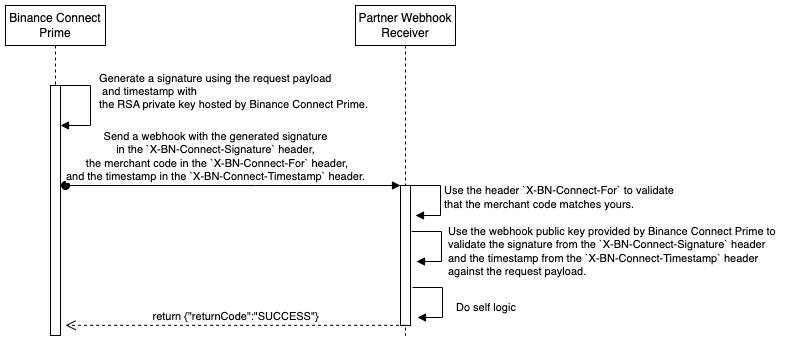
Verify signature
As mentioned above, Binance Pay Prime initiates a webhook request to the webhook callback url provided by the partner ( client). And the partner (client) should verify the identity of the request initiator based on the public key provided by Binance Pay Prime.
The example code below shows how to verify signature with public key:
Code
Example
Request Body:
Code